Building a Bridge? 5 Reasons Why it Should be Precast Concrete
Avg. Read Time: 3 min, 52 sec
Bridging the Gap
Short on time? Here are this article’s key takeaways…
Precast concrete bridges offer faster installation, often reducing construction timelines from months to days compared to cast-in-place bridges.
Durability is significantly higher, with precast systems commonly designed for 75+ year service lives, outperforming timber bridges and many culvert-based crossings.
Installation is more predictable, using modular components and standard equipment, reducing labor risk and jobsite uncertainty.
Hydraulic and environmental performance improves, especially compared to pipe culverts, box culverts, and concrete culverts that restrict natural stream flow.
If you’re planning a bridge project, one of the first decisions you’ll face is how the structure will be built. Traditional approaches such as cast-in-place bridges, concrete box culverts, pipe culverts, concrete arch bridges, and timber bridges have been used for decades. But each comes with tradeoffs in construction time, durability, and long-term performance.
Today, many engineers and contractors are turning to precast concrete modular bridge systems as a more efficient and reliable alternative. Designed with wet cast concrete, built in controlled environments, and delivered to the site ready for installation, these systems simplify construction projects while improving consistency and long-term outcomes.
Companies like Aster Brands and their global network of local producers have demonstrated how modular precast retaining wall systems, such as Redi-Rock and Novum Wall, can transform infrastructure projects by reducing uncertainty and improving repeatability. Modularity is now being extended to road crossing systems through solutions such as Velpont.
Here are five reasons why precast concrete is increasingly the preferred choice for modern bridge construction.
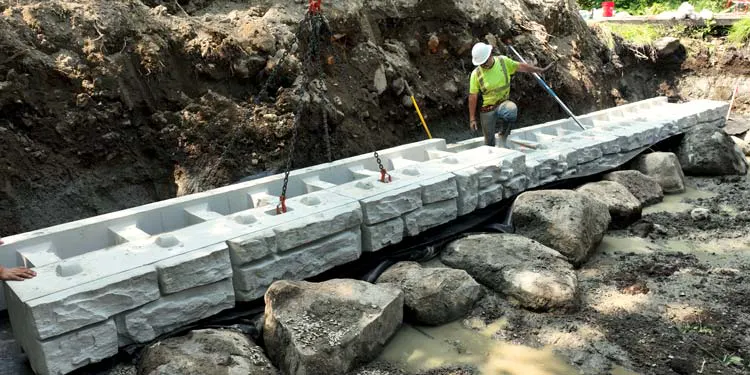
#1 – Faster Installation Reduces Project Risk
One of the most immediate advantages of precast concrete bridges is speed. Unlike cast-in-place bridges, which require formwork, pouring, curing, and multiple mobilizations, precast components are manufactured off-site and arrive ready to install. This allows construction to move forward quickly once site preparation is complete.
In many cases, traditional bridge construction timelines can take weeks to months, while precast modular bridge installations are often completed in a matter of days. This faster installation reduces exposure to weather delays, labor shortages, and equipment overruns.
Compared to box culverts, concrete culvert pipes, and pipe culverts, which often require extensive excavation and backfill, precast systems streamline construction and shorten schedules.
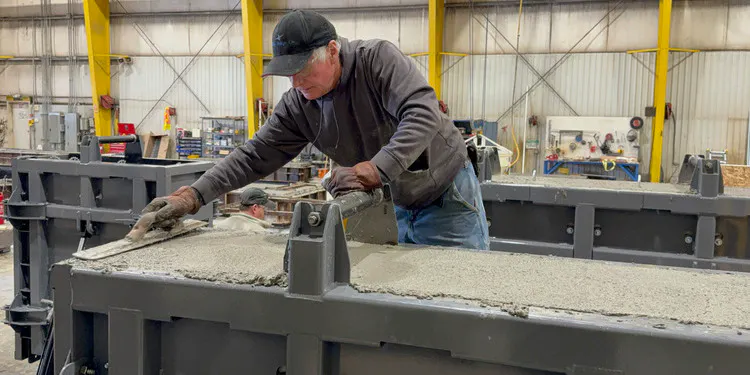
#2 – Consistent Quality Through Controlled Manufacturing
Precast components are manufactured in a controlled environment, resulting in greater consistency than site-built alternatives.
With wet cast concrete, manufacturers can:
- Maintain precise mix designs
- Ensure proper curing conditions
- Achieve consistent structural performance
- Produce deeply textured substructure components
The result is a bridge system with:
- Predictable strength and durability
- Reduced variability across projects
- Improved long-term performance
- Natural stone-inspired visual appeal
Compared to traditional culvert installations, this approach:
- Reduces turbidity (suspended particles that disrupt the stream’s ecosystem) during construction
- Limits disturbance to aquatic habitats
- Simplifies environmental permitting
This level of control is one reason precast systems are widely adopted across infrastructure products from Redi-Rock retaining walls to Novum Wall systems, and now increasingly in bridge construction.
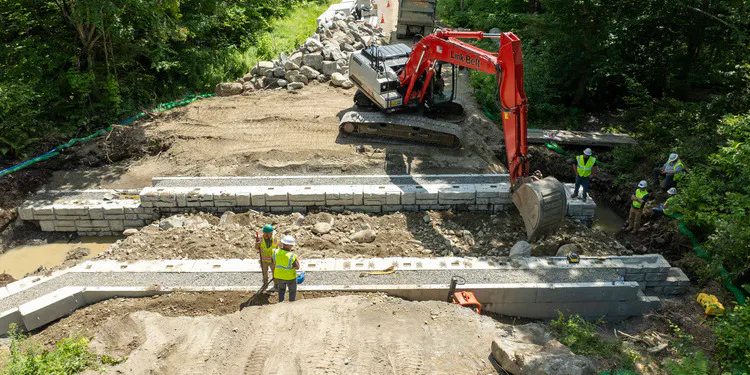
#3 - Long Service Life and Lower Lifecycle Costs
Bridge owners are not just building for today—they are planning for decades. Precast concrete bridges are typically designed for a service life of 75+ years, making them a long-term infrastructure solution. Their durability also helps them withstand harsh conditions, such as freeze-thaw cycles, which can degrade other materials over time.
By comparison:
- Timber bridges often require replacement in 20–30 years
- Steel pipe culverts and concrete culvert pipes may experience corrosion, blockage, or failure over time
- Box culverts and concrete arch bridges can require maintenance tied to joints, settlement, or hydraulic limitations
Longer service life translates to fewer replacements, reduced maintenance costs, and lower lifecycle environmental impact. When evaluated over time, precast systems often provide greater value, even when upfront material costs may be slightly higher.
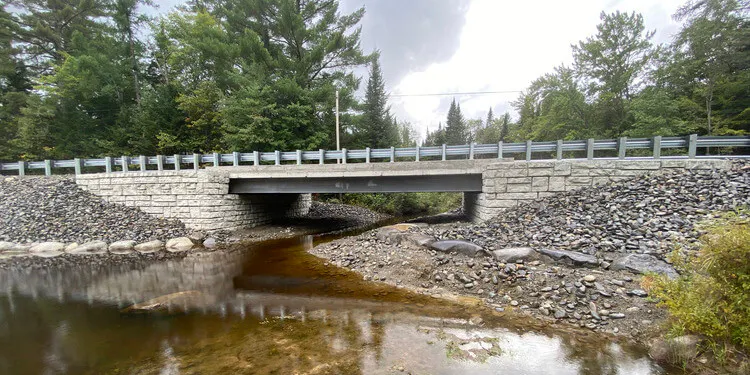
#4 - Improved Hydraulic and Environmental Performance
How a bridge structure interacts with water matters just as much as how it carries traffic. The environmental impact of a road-stream crossing is wide-ranging and can harm wildlife species or entire ecosystems for decades.
Traditional crossings, such as pipe culverts, box culverts, and concrete culvert pipes, move water through a confined opening. This can increase flow velocity, cause downstream erosion, alter sediment transport, and create barriers to the passage of aquatic organisms.
By contrast, many precast modular bridge systems are designed to:
- Span the channel instead of narrowing it
- Maintain natural stream flow and sediment movement
- Reduce the likelihood of debris blockages and overtopping (when water rises high enough to flow over the roadway)
The precast approach supports modern infrastructure priorities, including flood resilience, habitat connectivity, and stream stability. These benefits are increasingly important as agencies recognize the merit of Stream Smart–style design principles and incorporate them into long-term infrastructure plans.
#5 – Predictable Installation and Scalable Construction
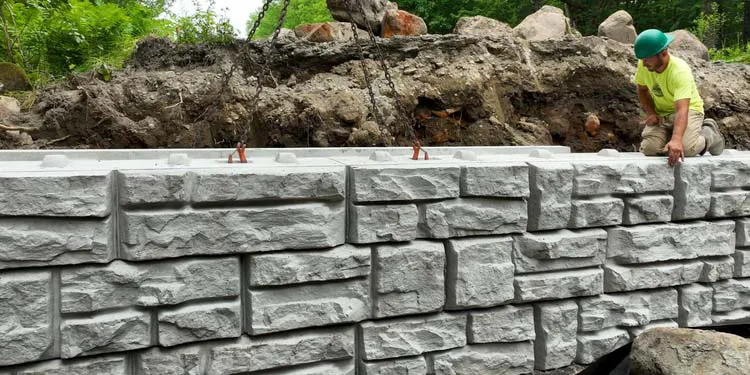
Construction predictability is one of the most overlooked advantages of precast concrete bridge systems. Because components are standardized and installation follows a defined sequence, contractors can:
- Plan labor and equipment more accurately
- Reduce reliance on specialized crews
- Minimize unexpected jobsite challenges
A typical installation requires an excavator or loader, a small crew (often 3-5 workers), and familiarity with standard construction practices. Compared to cast-in-place bridges or large concrete arch bridges, which often require specialized forming and extended schedules, precast systems offer a more repeatable and scalable construction approach. This repeatability is especially valuable for projects involving multiple bridge replacements or rural infrastructure upgrades.
The Bottom Line
Modern bridge construction is shifting toward solutions that reduce uncertainty while improving long-term outcomes. Precast concrete bridge systems provide a practical path forward by combining controlled manufacturing, faster installation, and durable materials into a single, repeatable solution.
For engineers, contractors, and project owners evaluating bridge options, the most effective choice is one that aligns construction efficiency, hydraulic performance, and lifecycle value with the site's realities.
Designing a crossing or preparing a bid?
Start with a system built to deliver predictable installation and lasting results.