Installing Velpont: How Long Does It Take and What Equipment Do I Need?
Avg. Read Time: 3 min, 10 sec
Bridging the Gap
Short on time? Here are this article’s key takeaways…
Velpont installations are often measured in days rather than weeks or months.
The system is designed around standard construction equipment, most commonly a loader or excavator.
Typical installation crews of 3-5 work primarily from the streambanks, which can reduce complexity, access challenges, and the likelihood of schedule overruns.
The installation sequence is defined and repeatable, helping contractors plan with confidence.
For contractors, municipalities, and landowners alike, installation is where bridge projects either stay on track… or don’t. Before drawings are finalized or materials are ordered, the same practical questions tend to surface:
- How long will construction take?
- What equipment will be required on site?
- How many people will it take to build the crossing?
Traditional crossings often make answering those questions difficult. Cast-in-place bridges, box culverts, and large pipe installations can involve extended schedules, specialized trades, and prolonged in-stream work, all of which introduce increasing uncertainty.
Velpont approaches installation differently. Its modular, precast bridge system replaces many unknowns with a defined installation process that allows installers to plan better and project owners to worry less.
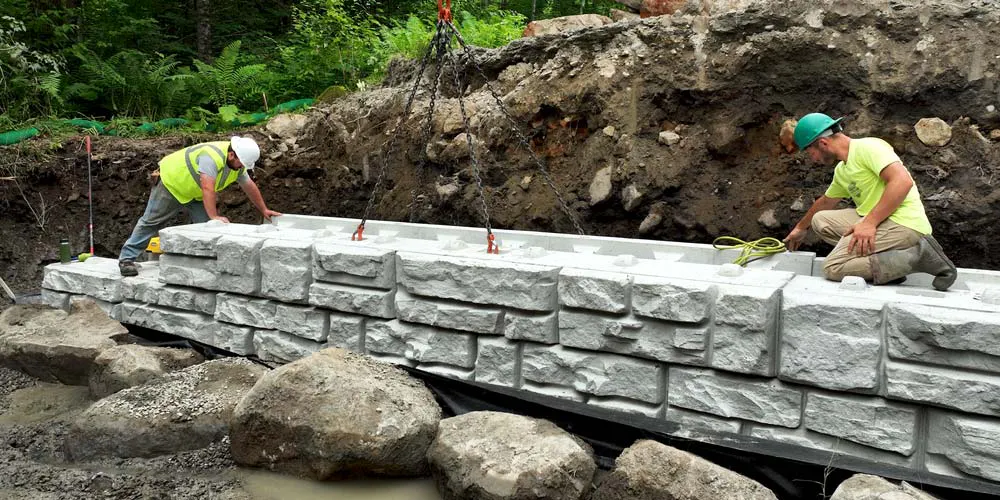
What is Velpont’s Usual Installation Timeline?
Velpont bridges are not installed instantly, but they are installed efficiently. In fact, many Velpont crossings are completed in just days.
Once site preparation is complete, most projects progress through construction quickly and without extended pauses. A typical sequence includes:
- Preparing the streambanks and base materials
- Setting precast abutment and corner blocks
- Installing the superstructure
- Completing approaches, grading, and restoration
Velpont’s bridge components are pre-fabricated off-site, so they arrive ready to install, allowing crews to avoid time-consuming formwork construction, concrete curing delays, and repeated mobilizations.
What Equipment is Typically Required?
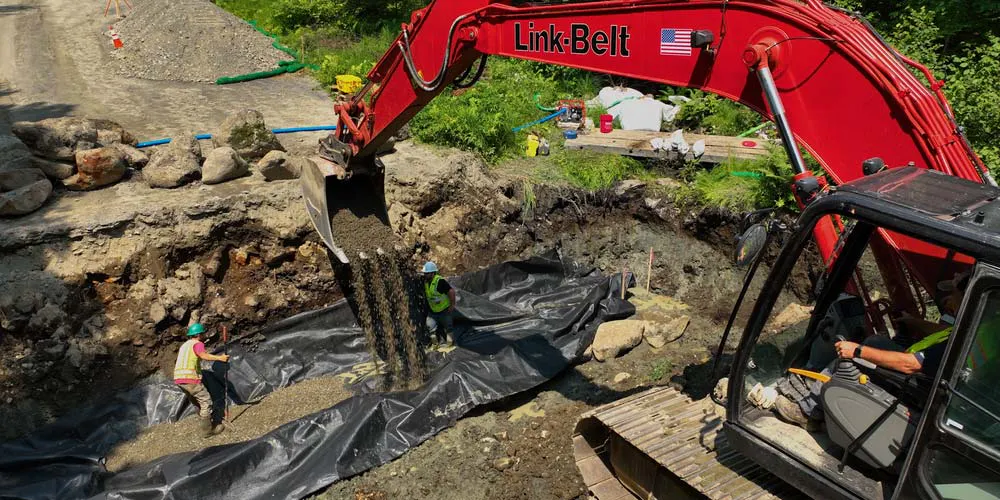
Velpont installations are intentionally designed around standard construction equipment that most civil contractors already have access to. Rather than relying on specialty bridge machinery often required for larger or more complex bridge structures, crews typically use:
- A 32.5-42.5 ton (29.5-38.6 t) machine, like a loader or excavator, for placing blocks
- A skid steer for material handling and backfill
- Standard lifting hardware, like chains and rigging, for component placement
- Compaction equipment, such as a plate compactor or roller, for bases and approaches
- Survey equipment to establish grades and elevations
- Hand tools like pry bars, hammers, and wrenches for alignment adjustments and rigging changes
Depending on the site and crossing design, rebar and concrete placement equipment, post-tensioning jacks, dewatering pumps, hoses, filtration systems, cofferdams, and other specialized equipment may be necessary.
In most cases, a Velpont crossing can be installed without heavy equipment such as a crane; however, some projects may require it. Utilizing an excavator or loader for installation can simplify access, reduce mobilization costs, and make Velpont practical in remote or environmentally constrained locations.
Is Dewatering Equipment Required for Installations?
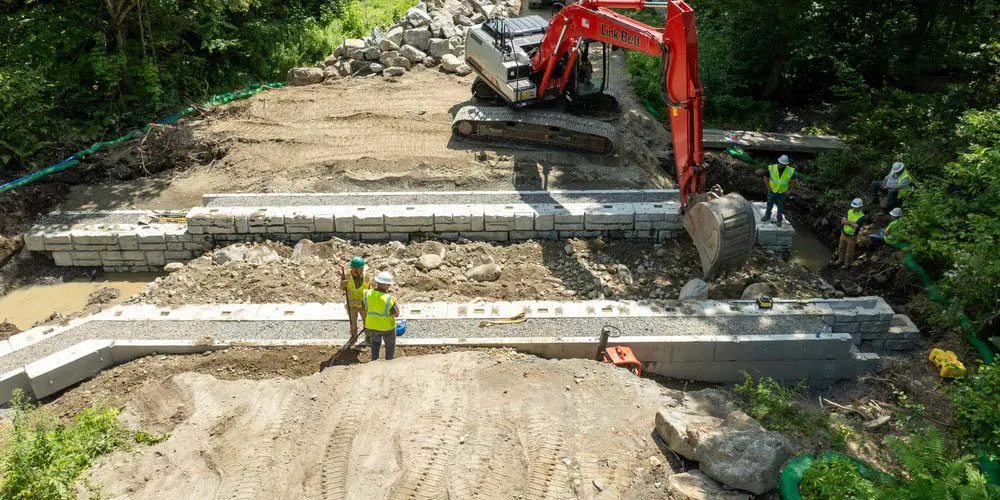
Velpont is engineered to minimize, or in some cases eliminate, the need for site dewatering. That said, some road-stream crossing projects may require temporary dewatering, depending on stream flow, site geometry, soil conditions, and permitting requirements.
Because Velpont abutments are typically installed from the streambanks rather than within the channel, many installations can proceed without fully diverting or isolating the stream. This approach often reduces the scope, duration, or complexity of dewatering compared to alternatives that require streambed excavation.
Certain site conditions, such as high flows, limited bank access, or regulatory constraints, may still require localized dewatering or flow control. When that occurs, Velpont’s efficient installation process and shorter work window help limit the duration of those measures.
What are the Crew Size and Experience Requirements?
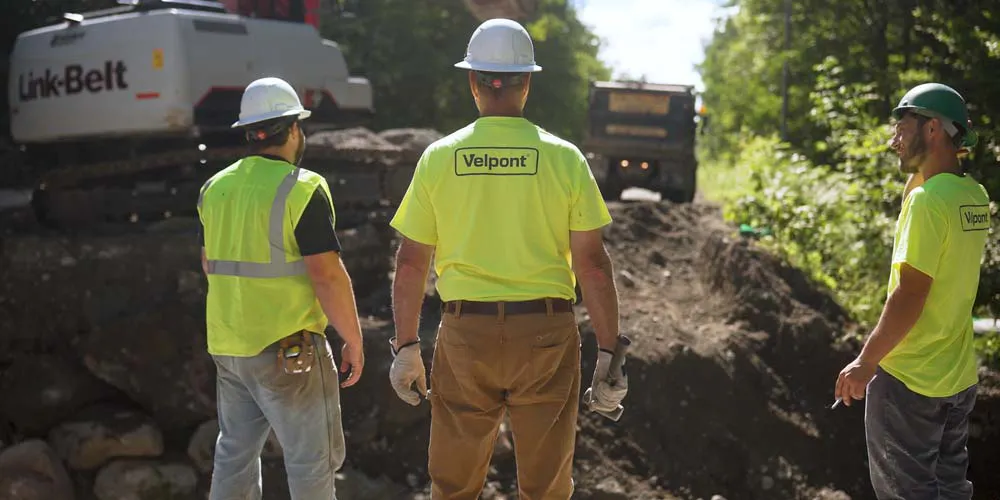
Traditional bridge construction often demands larger crews working for extended periods, particularly when forming, pouring, and curing concrete on site. Velpont’s modular approach allows installation to be completed with smaller crews. While exact staffing depends on site conditions and contractor preferences, a typical installation involves:
- An equipment operator (crane/loader/excavator and skid steer)
- Two or three laborers assisting with compacting, placement, rigging, and alignment
- A foreperson or superintendent overseeing sequencing and layout
Because blocks interlock, components are standardized, and installation steps are well-defined, crews spend less time improvising and more time executing.
For the project, this offers lower labor exposure and reduced coordination challenges, resulting in consistent daily progress.
A Smarter Approach to Crossing Construction
Velpont is designed for teams that want to build durable road crossings without overcomplicating construction. Faster timelines, familiar equipment, smaller crews, and reduced reliance on dewatering activities make it easier to deliver projects efficiently and control risk. Ultimately, simplified, efficient installation often delivers a significantly less expensive crossing project.