DESIGNING WITH VELPONT: MODULAR CROSSINGS MADE SIMPLE
Design using a single, modular system that replaces many one-off bridge alternatives engineers are typically forced to detail from scratch.
Resources for these components are currently in development and scheduled for availability later this year: - Foundation blocks - Slab beams - Backwall units - Coping
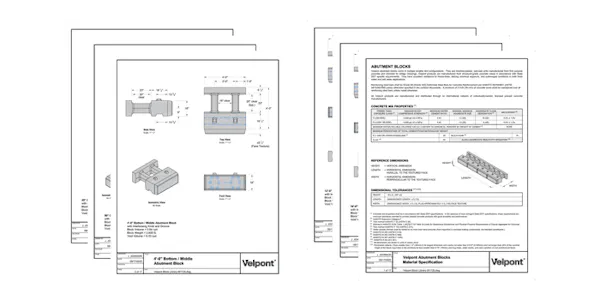
Designed for the crossing, not the catalog
Velpont supports small to medium-span crossings up to 75 ft (22.8 m) long and provides up to a 20 ft (6.1 m) rise, depending on site conditions.
Skewed Crossings
Standard abutment blocks can be paired with 45° or 90° corner blocks, allowing the layout to follow skewed road or stream alignments without introducing custom geometry or complex detailing.

Variable-Width Roadways
With versatile abutment lengths and superstructure configurations, Velpont supports non-standard roadway widths, eliminating the need to rework approaches or over-design the deck.

Constrained Locations
When access is limited or the site is tight, Velpont’s modularity allows the crossing to be built with minimal impact on the streambed and banks.
Alternatives Just Aren't Engineered Like Velpont
Velpont
Velpont spans the channel instead of narrowing it, allowing the waterway to function naturally across a wide range of conditions.
Alternatives
Over time, these impacts can reduce biodiversity, simplify stream structure, and require costly remediation or replacement.

Rooted in Best Practices
Stream Smart is a crossing design strategy that prioritizes preserving natural waterway width, grade, and sediment movement while still delivering safe, durable crossings.
Velpont is rooted in Stream Smart best practices and offers a responsible way to design crossings that perform hydraulically, structurally, and environmentally over the long term.
Quote Your Crossing
Define your site parameters and receive a clear, engineer-focused quote built around standardized Velpont components, not assumptions.
Frequently Asked Questions
What is the longest stream crossing that can host a Velpont bridge?
Velpont modular bridges can be used on crossings spanning up to 75 ft (22.8 m). Bridge designers will appreciate the flexibility this span offers when working with tricky sites.
How tall can Velpont bridges be built?
Velpont abutments can be constructed to allow up to a 20 ft (6.1 m) rise, depending on specific site conditions.
Does Velpont reduce permitting complexity?
Often, yes. The minimal in-stream work needed for installation can ease permitting requirements on contractors and bridge designers/engineers.
Why are Velpont abutment blocks crafted with voids?
The hollow core block design reduces weight for easier shipping and handling and allows additional concrete and rebar reinforcement during installation, creating a stronger, fully reinforced bridge.